Showing posts with label reviews and criticism. Show all posts

Saturday, August 25, 2007

Black Peter

[N.B.: I will be discussing certain events in the film, including the end; the film doesn't have a very strong "narrative" however, so I hesitate to write that this post contains "spoilers" because there's really not much to spoil]

Right in the middle of Milos Forman's Black Peter (1963) there's an extended sequence at a dance where we spend the majority of our time observing two losers as they try to pick up dates. Our main character, Peter, pops up occasionally, but in this particular sequence he seems like a cameo in his own film. There's a lot of awkward humor, and rock & roll, and it's all shot cinema verite-style, so it's perfect early Forman. What I especially loved about the sequence was the way Forman focuses (almost) exclusively on these two nerds (who were introduced in an earlier scene as dimwitted antagonists in a side plot) and slowly reveals their humanity. It's a long digression in a film that doesn't have much of a narrative to begin with, but it's got everything I love about Forman's Czech films: it's hilarious, true, unpredictable, and ultimately, humanizing. Forman shows us his characters' weaknesses, not just to ridicule them, but to humanize them. He enjoys making fun of the characters but he's never cruel about it.

It's not that Forman drops his dark humor -- he continues to ridicule the characters for their sad-sackhood and social awkwardness. But he doesn't let the audience get away with easy laughs either; he forces us to recognize ourselves in these characters, to see that we could be the butt of the joke just as easily if a camera were around to document all the embarrassing and painful moments of our own youth. Forman makes fun of his characters (and he can be brutal and black in his humor), but he always manages to give a moment -- a fleeting look, a line of dialogue, a small action -- that complicates things and makes the ridiculous character suddenly the saddest and most vulnerable. Fans of shows like The Office would find a lot to love in Forman's Czech films.

The dance sequence in Black Peter -- long and rambling, focused primarily on secondary characters, utilizing documentary-style techniques, diagetic use of popular music, etc. -- is a premiere example of Forman's early style. It's shot like a documentary, with the camera acting as observer, weaving in and out of the crowd as various characters try to find dates, get drinks, make jokes, and dance. We watch the drama unfold as if unscripted, as young people struggle (and often fail) to navigate their confusing social lives.

Black Peter is a youth film, a film for and about people moving from adolescence to adulthood that captures all the quiet rebellion, awkwardness, mischief, confusion, and ambivalence that accompanies that age. Since I'm just coming out of (or still stuck in, depending on which day of the week it is...) that period of my life, Black Peter resonated deeply. I was Peter in so many ways -- ambivalent toward work and family, anxious about sexual and romantic relationships, lacking a "proper" direction in life. Peter can be shy and bumbling, or he can be mischievous and sarcastic, and he certainly can't behave with adults in the way adults expect him to behave. He's too individualistic, too bemused, too awkward and yet too rebellious to fit in with the world his father inhabits, or the world of his job, or the social world of his peers.

There's a hilarious scene at the beginning where Peter follows a man he suspects of shoplifting. Peter works at a grocery store where it's his job to spy on the customers and look for possible thieves (obvious parallels to Communism and the police state of course). The scene -- with Peter following the man for blocks, past shops and passersby, trying to confront him over the shoplifting, but like an inept Inspector Clouseau, unable to bring himself to even make eye contact with the man, all while the man casually ignores Peter -- is a cinematic metaphor for those uncomfortable, unsure attempts of young people to navigate an indifferent and seemingly more powerful adult world. Throughout the sequence the man has complete control despite the fact that he's the one being tailed; he's the adult and Peter is reduced to a boy who's merely playing at being a spy.

I have to admit, the scene could be a metaphor for my own bumbling experiences with older people. I know that in a lot of my interactions with people several years older than myself, I'm still a "kid" and they're the "adults," and the power in these cases is firmly in the hands of the adults.

Black Peter explores this theme a lot, not just in work situations but also at home with Peter's parents, and even in the scenes with Peter and other young people. There's an unmistakable sense that Peter is different -- not necessarily smarter or better but certainly a square peg, unable or unwilling to fit himself into the roles people have assigned to him. An alternate title for the film is, in fact, Black Sheep. Peter's cynical humor, lackadaisical ambivalence, and the annoyed frustration that springs from his social awkwardness are all traits with which I identified (and I expect others my age or younger would respond to as well; I'm curious what the middle-aged or older response to the film might be...). And of course, the theme of individualism that runs throughout the film is a response to the conformity and restrictiveness (thanks to Soviet Communism) of Czech life in the '40s and '50s that was only beginning to thaw in the 1960s.

A small victory for Peter, and the individualism and youth he symbolizes, comes in the last scene as Peter must endure yet another lecture from his conformist father. As Peter sits and grows increasingly annoyed by his father's exhortations, suddenly the movie shifts into the absurd and the camera freeze frames on the father, freezing him in mid rant.
But this is not like the freeze frame in something like Truffaut's 400 Blows, where the frame stops and the film ends. Instead, it's only Peter's father who has been frozen; Peter himself continues to move in his own frame and sits dumbfounded as he witnesses his father's cinematic paralysis. In a bit of self-reflexivity, Forman freezes the film on the father but allows Peter to continue to move and "live" within his own frame, with Peter being fully aware that his father's frame has stopped. Whether by an act of God, or simply the joking act of some unseen director, Peter is left to shake his head, do a double take, and wonder. The viewer is left with a delightful, if often times dark, comedy about the trials of not quite fitting in.

As far as I know the film is only available in the U.S. from Facets Video in a lousy transfer with terrible subtitles; the subtitles are barely matched up with whoever is speaking and several lines of dialogue are simply not translated. As unfortunate as this is (especially since Forman's other two films from this period -- Loves of a Blonde and Fireman's Ball -- are both available from Criterion) Black Peter is still worth seeing; the awkward humor comes through despite the poor subtitling.

Tuesday, August 21, 2007

The List Post

So, I participated in the initial round of Edward Copeland's Foreign Film list thing, and first, can I just say: Who the hell let the bum (me) in?! Seriously, the names of the participants are like a who's who of awesome film writers and then there's me. Yeah. "One of these things is not like the others" and all that. So a great big "thanks" to Mr. Copeland for his hard work on a very fun enterprise (I've been having a blast all week, watching films and analyzing them, and thinking about my tastes, and looking at my list and seeing how it reflects on my personality, etc.), and thanks also for being open to the opinions of bums like me!

One thing I've noticed in all this list-making craze (AFI, Online Top 100, Eddie's awesomeness) is how a lot of us are embarrassed about the films we haven't seen, or the guilty-pleasure films we've included on our personal lists, or the final product itself as having missed too many old movies or obscure masterpieces, or included too many mainstream popcorn flicks or predictable "classics". I feel like sometimes people (myself included) approach list making as an exercise in trying to look good. There's that thought process where we want to include something but we're afraid of "what people might think", so we leave it off and throw something with a little more cache on there to make ourselves seem cooler and smarter, more "with it", etc.

I know I almost succumbed to this desire. But with this new list we weren't being asked specifically for THE BEST, but a combination of criteria, sort of a "really good films that you totally love, but don't worry this isn't a canon" kinda thing. So when I feared what people might say if I put Cinema Paradiso on my list (hey, I cried okay? That movie really moved me, man!) I decided, frak it, I'm going with it and I'm proud of it. (And it made the uber-ballot, so, yay!)

Random Thought: Yeah, so snobs cling to certain things -- knowledge of wines, indie rock, for example -- and feel superior to other people because they know all about and like these specific “cool” things. The elitist doesn’t even have to like the thing in question, she must merely recognize that SOMEONE should like the thing, claim it as objectively good, and champion it as worth preserving. I’m a sometime-elitist. I’m not a snob (I hope). I think the films of great foreign directors are worth celebrating and preserving and that love of these films should be cultivated, as far as it’s possible, with a wider audience. Just don’t get down on me ’cause I’m not all that interested personally in Hsiao-hsien Hou or Pather Panchali.

I guess what I'm getting at is that I just don't see the value in trying to impress with something like a list. The Online Film Community's Top 100 is not a reflection of my tastes (and I didn't participate in it, so that makes sense), but it is a reflection of something, it says something about what the participants are into (even if on an individual basis people's votes looked different), and in that way it's interesting and has started some really fantastic discussions. Does it bum me out that a lot of older (pre-1960) movies haven't been seen or enjoyed by a portion (though, who can say how large?) of internet film bloggers? Yeah, fo' sho', since old movies are my thing. But the great thing about Cine-blog world is that we can just get another list going if we want, and in this case, we have.

So, let out your inner sentimentalist! Don't be afraid to be thought an inexperienced whelp! Philistines unite! Share your list, embarrassing movies and all, for the world to see! You know, whatever.

So, yeah, don't be embarrassed if you think some mainstream hit movie is better than the Three Colors trilogy. You might be wrong, of course, but the debate and discussion that follows is where it's at anyway. (And the "you" here is me kinda talking to myself, just so you know.)

Random Thought: Gosh, now I sound like those young punks who snivel and snark on pre-1970s (or, as my generation seems to say: “when movies were slow, boring, and black and white, but for some reason everybody talked unnaturally fast“) and foreign pictures (which are not only slow, boring, and black and white, but also subtitled -- more work!). That is not me. Please believe me.

Another Random Thought: I think the foreign films I love, so far, skew young because I am young (relatively. 26.) (and I had that particular thought as I watched for the first time and added to my favorites A bout de souffle). Tokyo Drifter, Port of Shadows, Black Peter. Not exactly Cries and Whispers or Tokyo Story, but it’s some of what I’ve seen and loved. I’ve only had about eight years of serious, deliberate cinema study under my belt, and much of it has been devoted to pre-1960s American cinema, so I’ve got a ways to go.

Anyway, here's my (totally embarrassment free) (well, maybe there's a little (teeny, tiny) bit of embarrassment for Farewell, My Concubine, but it's just a smidge, a tiny, tiny smidge):

LIST
Grand Illusion
Only Yesterday (Japanese title: Omohide poro poro)
Day of Wrath
Farewell, My Concubine
Nights of Cabiria
Daisies
M
Gospel According to St. Matthew
The Conformist
Black Peter
Tokyo Drifter
Exterminating Angel
Cinema Paradiso
Eyes Without a Face
Loves of a Blonde
Breathless
Quai des Brumes (Port of Shadows)
Shoot the Piano Player
La Belle et la bete
Umbrellas of Cherbourg
Viridiana
Ordet

Also (movies I should have included and I don't know why I didn't, I'm stupid):

Rashomon
Rules of the Game
Man Is Not a Bird
Battle of Algiers

Will I write more about these films? Possibly. Very, very possibly. I am a lazy bum though, so, you know...

Monday, July 16, 2007

These Dreams Are Dark

But in a good way.

More Harry stuff, this time an awesome bit of criticism from Matt Zoller Seitz at House:

The film's alternately doubting and exultant mood -- encapsulated by Radcliffe's nuanced performance -- at times reminded me of George Harrison's great solo debut, All Things Must Pass, arguably flower-power-rock's most moving contemplation of love, cruelty, spiritual yearning and the quest for self-knowledge. One of its finest songs, "Beware of Darkness," could double as the viewer's admonition to Harry:
Watch out now, take care
Beware of the thoughts that linger
Winding up inside your head
The hopelessness around you
In the dead of night

Beware of sadness
It can hit you
It can hurt you
Make you sore and what is more
That is not what you are here for.
snip

... Another, more moving example occurs in a scene in the forest outside Hogwarts where Harry talks to Luna Lovegood (why the James Bond films didn't already use this name is a mystery) while feeding thestrals, spooky creatures that look like skinless winged horses. Luna explains to Harry that thestrals "can only be seen by people who've seen death." As she tells Harry of her mother's demise in a spell-casting accident, she feeds a baby thestral, first by tossing it an apple (which it ignores), then a slab of red meat (which it devours). When the foal's snout dips toward the meat, Yates cuts to a scene in Hogwarts' mess hall, starting with a closeup of Ron Weasley tearing into a sausage. This, too, initially reads as a mere sight gag, but it plugs into the story's core as surely as the paper airplane business. Harry, Luna, Ron and the series' other significant young characters are baby thestrals -- unsettling but deep-down-beautiful creatures whose specialness is associated with trauma.

snip


...and most delightful of all, Alan Rickman as Snape. Rickman's line readings, like Ian McDiarmid's in the Star Wars films, have a self-awareness which suggests the character realized long ago that he was a character in a drama and can't believe no one else has figured it out. (He's the Thomas Crown of acting: there's no scene he can't steal.) The film's admixture of unease and joy holds together, and it's consistent with Sirius Black's assurance to Harry that darkness and light coexist in every human soul, and that "what matters is what we choose to act on. That's who we really are."

Read it all, including the comments.

Saturday, July 14, 2007

The Patented Rickmanian Pause

If you want to find out what that is, and what my thoughts on Harry Potter and the Order of the Phoenix (David Yates, 2007) are, just read Cacciaguida. He and I are pretty much on the same wave length (scroll down to find it).

Sunday, July 08, 2007

Kids love crap


First, a rather lengthy quote, though one that I hope is as intriguing to the reader as it is to me (from C.S. Lewis's essay "Different Tastes in Literature," reprinted in On Stories and Other Essays On Literature):

I was suggesting last week that bad art is never really enjoyed in the same sense in which good art is enjoyed. It is only 'liked'; it never startles, prostrates, and takes captive. Now if I say that, I come up against a difficulty. It has never been better put than by that fine and neglected artist, Mr. Forrest Reid. In the little autobiography called Apostate he describes his delight, as a boy, in Miss Marie Corelli's Ardath. Even at that age the last part seemed to him 'so bad that it weakened the impression of what had gone before.' But that earlier impression remained. Perhaps wisely Mr. Reid has not risked an adult re-reading. He has feared that 'its gorgeousness would all too likely strike me as vulgarity, its passionate adventure as melodrama, its poetry as a crude straining after effect.' But none the less, adds Mr. Reid (who is as little likely as any man alive to be deceived in such a matter), there is no use in 'pretending that the old pleasure was not an aesthetic pleasure at all. It was. That is the whole point,' and he contributes the important suggestion: 'What I got then probably was the Ardath of Miss Corelli's imagination; what I should get now would be the very much less splendid Ardath of her actual achievement.'

This diagnosis may not be correct. Mr. Reid may have got the Ardath of the author's imagination, or he may have got the Ardath of his own; that is, he may really have been enjoying an embryonic composition of his own stimulated by mere hints in the book. But it is not necessary to decide between these two possibilities. The point is that, on either view, he was enjoying the book not for what it really was but for what it was not. And this sort of thing very often happens when the reader is imaginatively superior to the author, and is also young and uncritical. Thus for a boy in the first bloom of his imagination the crudest picture of a galleon under sail may do all that is necessary. Indeed he hardly sees the picture at all. At the first hint he is a thousand miles away, the brine is on his lips, her head rising and falling, and gulls have come to show that undiscovered country is near.


So far in my childhood movie series I've been pleasantly surprised by half-remembered movies like Fantasia, Pinocchio, and Dumbo; or I've been haunted and re-enchanted by perennial favorites like The Wizard of Oz; or I've been delighted to discover that my childhood tastes were actually quite good, with the rediscovery of the low-key and charming The Sword in the Stone. But now I've hit that disappointment which Forrest Reid was so fortunate to avoid by not re-reading his childhood favorite: The New Adventures of Pippi-Longstocking -- a movie that I loved as a child and wished were real (if only so Pippi and I could scrub clean our treehouse with broom-skates) -- is a bad movie. It is crap. It's tedious, episodic (in the worst way), badly acted, badly scripted, insipidly directed, and blemished by hideously 80s musical numbers (though I have to say, that title song is still as catchy as ever... Pippi Longstocking is coming into your world! That freckle-faced red-head girl you ought a know!). Tami Erin, as Pippi, is almost completely without charm, and her character, instead of being whimsical and carefree, is downright snotty and spoiled. I'm sure as a child I was on the side of Pippi. Today, I'm decidedly on the side of Miss Banister. Pippi is a brat.

It's not a mystery why I liked the movie so much as a kid: there are elements of a good movie here, but as is so often the case with bad movies, no one involved in the filmmaking process knew what to do with the real elements of entertainment that peeked through the dreck. As Lewis and Reid in the quote above point out, I was seeing the movie of my imagination, not the movie that was actually up on the screen. I was seeing broom-skates; flying on motorcycles and in "gyro-planes" with broken propellers; walking on walls and ceilings; living alone and eating pancakes in the middle of the night; having a talking horse and a monkey for companions; not having to go to school; ice cream fights and parades down main street; sticking your entire face into a cake for no reason; saving children from burning buildings by walking across a tightrope (Also: Did this movie contribute to my fear of fire? I would say yes, since that scene with the man throwing his cigarette into the pile of old mattresses and junk is less of a movie scene and more of a recurring nightmare that I've had for years -- Did it really all start with Pippi Longstocking?! The power of cinema, my friends...); being a pirate and having a cannibal king for a father. All these things and more, in my own imagination, were fashioned into a movie that was as carefree and adventurous as I wished my own life to be at seven years old. Through the cold, hard eyes of adulthood, I can now see that those things (the magic and wonderment) weren't really in the movie itself, at least not fully, or in any successful way was a work of art. They were only hinted at by the movie, hints and glimpses and unsuccessful attempts at whimsy that only became memorable because my own imagination absorbed them and made them into something with the power of a real work of art.

That cleaning scene where the kids skate around on brooms fashioned like roller skates is a perfect example. When I was a kid, that scene was the inspiration for many a dream of having a huge treehouse, a club house for my friend Andy and me, and we'd clean it by making broom-skates just like Pippi had used. It was my dream, for quite a few years after seeing the movie, to be crazy and wild like Pippi, to live in our club house and skate around with brooms on our feet. That it never came true only increased in my mind the fantasy and enchantment of that movie scene. And then I watched it the other day, and saw indeed those elements that had enthralled me as a child. But I also saw, couldn't help but see, how in the hands of a better director, a better script, and better actors, that scene could have truly been the scene of my imagination, instead of the weak, competent-but-completely-inartistic typical '80s kids movie crap-fest. Nearly every scene worth remembering was like that: a good idea ruined by poor filmmaking.

This whole experience seems to me to prove (in the way anecdotal evidence so definitively proves our pet theories) that kids, because they lack the critical eye, can very often fall in love with crap. They can dream and fantasize about and fashion great art from the most insipid hack work because they let their own imaginations fill in the bad spots. How many children a few years younger than I look back with longing on junk like Power Rangers and Pokemon, and how many of my own generation still cling to memories of things like, yes, Transformers. And that's just it: This junk is remembered not as it is, but as we wished it to be. The stories a child creates in his head of giant robots, of red-headed freckle-faced girls, of ninjas, are more thrilling than the swill that swill-makers peddle out every day for children to consume, but children consume it because children have the capacity to see beyond it to the stories of their imaginations, the stories that junk art is only able to hint at, but which provide the child's imagination with a thousand adventures and thrills.

I've decided to dump a few titles from my list of childhood movies I was going to rediscover, because I don't want to have my pleasant memories of these films dimmed by the reality that comes with viewing them with a more critical, adult eye. For some reason, call me crazy, I have a sinking feeling that if I watched it today, I wouldn't like Howard the Duck nearly as much as I did as a kid. Maybe I'll just let the memory of the movie endure, instead of crushing it with the weight of reality. Alas, for Pippi -- her movie, and my memory of it, were not so fortunate.

Friday, June 22, 2007

Quick Grades

Spiderman 3 (Sam Raimi, 2007, B) (I like crazy, overstuffed messes, okay?)
Knocked Up (Judd Apatow, 2007, B+)
Nights of Cabiria (Federico Fellini, 1957, A)
Ratatouille (Brad Bird, 2007, A)
Bringing Up Baby (Howard Hawks, 1938, A+) (Yes, I've seen this one before, but it's been awhile and I had forgotten how completely hilarious this movie is -- let's just say, I don't give out A+s very often.)

Wednesday, February 07, 2007

Quick grades


Nashville (Robert Altman, 1975, A-)
Shane (George Stevens, 1953, B+)
Arizona (Wesley Ruggles, 1940, B+)
The More the Merrier (George Stevens, 1943, A-)
Too Many Husbands (Wesley Ruggles, 1940, B)
Purple Rose of Cairo (Woody Allen, 1985, A)
Hollywood Canteen (Delmer Daves, 1944, B)
The Show (Tod Browning, 1927, B-)
Kapo (Gillo Pontecorvo, 1959, A-)

Tuesday, December 26, 2006

"Happy Christmas, Harry!" "Happy Christmas, Ron!"


Well, I had a very nice Christmas, getting more than half a dozen classic movie box sets that I can't wait to break open. I love what Warner Bros. has done with their classic dvds, the whole "Warner's Night at the Movies" feature with classic shorts, cartoons, and trailers. I'm almost more excited about them than I am about the movies themeselves!

I've also seen some great films these past couple of weeks, and I may write about them and I may not, but regardless, I've enjoyed myself. I have a particular weakness for corny and sentimental movies around Christmas, so take that into account when you see some of these grades:

Our Vines Have Tender Grapes (Roy Rowland, 1945, A-)
Holiday Affair (Don Hartman, 1949, B)
The Ladykillers (Alexander Mackendrick, 1955, A-)
The Human Comedy (Clarence Brown, 1943, A-)
Kitty Foyle (Sam Wood, 1940, B-)
L.A. Confidential (Curtis Hanson, 1997, A-)
Sophie Scholl: The Final Days (Marc Rothemund, 2005, A)
The Secret Garden (Fred M. Wilcox, 1949, C+)
All Mine to Give (Allen Reisner, 1957, B+)
The Holiday (Nancy Meyers, 2006, B-)
We Are Marshall (McG, 2006, B)

Monday, December 04, 2006

Tortilla Flat (Victor Fleming, 1942, B-)


This is an adaptation of the John Steinbeck book about a group of paisanos in California who work hard at not working hard. Danny (John Garfield) is the "hero" of the piece, trying to change his ways to impress Dolores (Hedy Lamarr), while his best friend Pilon (Spencer Tracy) spends most of the film conning people and trying to keep Danny away from Dolores. Tracy's accent is laughable, and the attempts at humor for the most part fall flat. Hedy Lamarr, who can give a good performance as evidenced by her work in H.M. Pulham, Esq. (King Vidor, 1941), spends most of her time overacting in a poorly written plot. My suspicion is that Lamarr needed a stronger director, someone more adept at handling women's parts, than Victor Fleming, who was often thought of as a "man's director." Myrna Loy and Vivien Leigh have given great performances under Fleming, but they were better actresses than Hedy. Lamarr needed more help than Fleming was able to provide.

The other great surprise was that Tracy could be so annoying. The bad accent had something to do with it, but most was due to the unlikable character he played. Pilon is selfish, sometimes cruel, and even as he tries to help Danny, it still feels like he's only doing it to make himself feel better. I suspect we were supposed to find Pilon's antics somewhat humorous, but instead he comes across as immature and destructive. The only thing funny about the movie is the accents and I doubt that was the intent (also, it's interesting to note that, once again, classic Hollywood hears someone with a foreign accent -- Lamarr -- and thinks they can play anyone with an accent, nevermind that Hedy's accent is German while her character's is Spanish -- kinda ruins whatever illusion of verisimilitude they were going for).

What saves the film is Frank Morgan's (Oscar-nominated) performance as Pirate, the old vagabond with a touching piety and gentle heart. It's no coincidence that Morgan has the best accent of the bunch and gives the best performance: he takes his character seriously, embodying the spirit of a simple man who loves dogs and St. Francis. Tracy, for all of his skill as an actor, never seems to take Pilon seriously as a character; Tracy always seems to be winking at the audience throughout his performance. Morgan's storyline -- a poor man who saves all of his money in order to buy a candle for the church -- is actually more interesting than the main one about Danny, Dolores, and Pilon. The scene where Pirate prays to St. Francis in the woods while his dogs yelp and jump at his feet is one of the truest displays of religious feeling I've seen in a film.

Monday, November 27, 2006

You Know What Really Grinds My Gears?

I've noticed over the past couple of years (I dunno, maybe it's been happening longer and I just never noticed) is that mainstream critics -- newspaper critics, magazine critics, TV critics, many online critics -- all tend to adopt a "script" about certain movies and then proceed to view these movies only through that script. For The Passion of the Christ it was the possible anti-Semitism of the film; for Brokeback Mountain it was the gay romance angle and how the film was breaking down prejudices against Gay and Lesbian people in America; now for Borat it's the angle that the movie is some great social commentary revealing the "hidden prejudices in America." The angle, in such cases, takes over the conversation about the movie to the point that nearly every major review or commentary approaches the film from that angle and the film gets defined as being "about" that before the audience has even seen the film. This, of course, isn't limited to film criticism and movie reviews -- the media has a tendency to approach a story in only one way and that one way is the one that dominates our national conversation about the story. But I'm getting kind of annoyed by this in film criticism since film is what I'm most interested in and I hate how the conversation gets defined before the audience has even had a chance to see the film and decide for itself.

Borat is the latest example of this, where everyone has been told for months that the film is all about exposing the prejudices of "average" Americans so people go into the movie expecting it to be about this, and since the movie does have a few scenes where Americans act like bigoted, disgusting jerks, people think they've seen some ground-breaking work of social satire.

Am I being too condescending toward the audience? Am I giving critics too much credit and the audience not enough? Maybe. I would hope that people are able to see films for what they are and not have their opinions dictated to them by the media or so-called experts. Maybe I'm getting hot and bothered for nothing and most people in the audiences for Borat recognize that they aren't laughing at the frat boys' stupid remarks because, frankly, their gross remarks aren't funny, but that they're laughing at Borat and his silly, over-the-top comments, and his zany slapstick. For the most part, the comedy in Borat doesn't come from the awful remarks made by a few frat boys and rednecks; the comedy comes from Borat himself. But the way the media hype surrounding the movie would have it, you'd think you were watching a two-hour masterpiece of groundbreaking social satire. I hate the way the conversation gets started about a film and everyone just echoes and parrots the same few things that the mainstream critics have all glommed onto.

I am encouraged by the Internet, of course, and the fact that more people have a voice now and can enter the conversation instead of just being suffocated by the conversations of others (i.e.: "professionals"). To take Borat as an example again, there's the commentary by Christopher Hitchens which I think makes some good points (and of course, some points I happen to agree with, see my review below), and then there's Jim Emerson's response, which also makes some excellent points, and analyzes the film in its relation to traditional cinematic comedy (as opposed to its status as social commentary), something I'm afraid I've found very little of in the mainstream reviews that welcomed the movie into theaters. Hitchens and Emerson are, of course, both part of the mainstream themselves, in a way that I, the humble nobody blogger, am not. But they're engaging the film in a way that is based on actually thinking about it as individuals and not just parroting a lot of movie reviewer groupthink. That's what's refreshing, and I hope the more I explore this whole film blogger thing the more I'll encounter this kind of individualism in criticism. At this point, I'm pretty much sick to death of the professional reviewer scene, because it seems like there's always a specific "line" on a movie -- it's this, it's that, it's got this controversy surrounding it, it's got that scandal accompanying it -- and whatever the line is the reviewer can't help but reduce the film to that one thing. I suspect what people like Hitchens and Jonah Goldberg are reacting to (I can't comment on David Brooks, whom Emerson mentions, because I don't subscribe to the New York Times online) is not so much the movie Borat itself, but the national conversation that seems to have arisen around it. The "line" on a film has already been written, and so that's what the movie "is," whether we like it or not.

Sorry for the rant, but I say not.

Sunday, November 12, 2006

The Conformist (Bernardo Bertolucci, 1970, B+)


I didn't really get anything out of this film thematically; all of the stuff about sex and fascism and wanting to conform and appear normal left me cold. Frankly, I'm just not interested in sex as a subject matter unless it's about how sex isn't as crazy-fun and non-committal as modern Western culture would have it. So right there Bertolucci loses me.

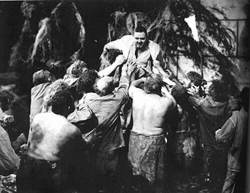
But, hoo boy, is this film beautiful! I mean, gorgeous. Probably one of the top five most beautifully photographed films I've ever seen. The use of color for one thing, right off the bat with the contrasting redish-browns of the first scene to the somber blues of the next scene, to the stark, clean whites and blacks of several of the scenes at fascist headquarters. I especially loved the softness of the lighting used on the female leads. Bertolucci was able to make their faces look as luminous and flawless (in color) as the beautiful black and white faces of Hollywood's glamour heydays of the 30s and 40s. For me this film was all about the aesthetic pleasures of gazing at these dream-like images, with narrative reduced to a secondary, or even tertiary position. I really wasn't invested in whether Marcello (Jean-Louis Trintignant) would let his former professor be killed, or whether he'd save Anna (Dominique Sanda) from a similar fate. All I cared about was the haunting image of Professor Quandri surrounded by assasins and trees in the yellow light of the dawn. The whole film was just a pleasure (and a nightmare) to look at. In a way, this movie is an example of how cinema is not as strongly tied to narrative and storytelling as we so often would like to think. Even a movie that doesn't have a strong story or a compelling theme can be a powerful, moving, important experience. Like our experience with dreams, the images from The Conformist will linger indefinitely, while its meaning will most likely be forgotten.

Island of Lost Souls (Erle C. Kenton, 1933, B-)


Not as scary as I hoped, mostly due to the fact that the male lead, Richard Arlen, hardly seemed bothered by the freakish experiments of Dr. Moreau (Charles Laughton). His performance throughout the film was one of mild irritation, as if the men-beasts and panther woman weren't frightening monsters and twisted perversions of nature but unwelcome dinner guests or something. Not good.

But Laughton's performance makes up for it, as he's so deliciously cool, and evil, and crazy, and charming. He's hamming it up, sure, but it's one of those hammy performances that's actually menacing (take note Brando, whose own Dr. Moreau was just ridiculous). Moreau, of course, isn't bothered by such petty things as morality, being one of those Dr. Frankenstein types who believes he can conquer nature, and Laughton is just that right mix of charisma and arrogance and intelligence that can make even the cruelest and sickest of scientific experiments seem "important" and "revolutionary" and "good." Of course, they're not, and Moreau soon finds out what really happens when you turn beasts into men.

The make-up work on the men-beasts is fantastic, and though Lota the panther woman looks human for the most part, the reveal of her beastly claws was creepy as hell. Definitely the scariest stuff in the film comes from the grotesque faces of the men-beasts lurking in the shadows of Moreau's tropical island. When their true deformities are revealed in close-ups at the end, it's pretty cool, and I was definitely disturbed by Moreau's demise.

Watch (or I should say, listen, as it's hard to tell it's him from appearances) for Bela Lugosi's supporting role, and marvel as well at some pretty graphic pre-Code violence.

The Fastest Gun Alive (Russell Rouse, 1956, B-)


Great black and white cinematography and a solid performance from Glenn Ford. Unfortunately, Jeanne Crain, whom I usually like, overacts. She reads every line with this sort of tragic voice of weariness and disappointment and it gets a little tiresome after awhile. But it was nice to see Glenn Ford in the genre he's most known for, the western. Confession, I've never actually seen any Glenn Ford movies before, this was my first, and I was struck by his naturalistic performance and his almost James Dean-like line delivery, sometimes speaking in an under-the-breath sort of way, sometimes talking too fast or talking over someone else's lines, or just talking in an off-hand sort of way, as if he were just talking and not reading lines from a script. I liked it and I hope to see more Glenn Ford pictures in the future.

I also enjoyed the shoot-out at the end of the movie. For a film called "Fastest Gun Alive" one expects some fast gun work, and the first gun shot of the final duel doesn't disappoint. Using misdirection through dialogue and camera work, the shot really does "feel" fast, as it took me by surprise. At first, Ford and Broderick Crawford's bad guy get the typical shoot-out-at-high-noon treatment, with a sequence of shots showing the two men slowly approaching the middle of the street, overhead shots that emphasize the distance still between them, their figures positioned at the edges of the frame as they gradually close in on one another, etc. But when the first shot is fired, the characters aren't being filmed in that typical "here comes the first shot" kind of way; the camera is just resting easily as if this were another typical dialogue scene before the shooting starts. And then suddenly the shooting starts. It's pretty effective and one of the better shoot-out scenes I've seen (not that I've seen very many, admitedly).

Russ Tamblyn also co-stars and has a high-spirited dance number that seems out-of-place in this otherwise gloomy sort of western. Music is, to my surprise, by Andre Previn.

Monday, November 06, 2006

Random stuff

Jim Emerson has a post up taking Anthony Lane and Armond White to task for their lame reviews of Borat, but I was actually more fascinated by the reader comments, many of which make some great observations about the movie. Check it out.

Also, one of the commentors links to a piece by Noel Murray at the A.V. Club blog which makes almost the exact same point I made in my review of Borat, namely, that it's not really the crackerjack social commentary it's being billed as.

Finally, I'm starting to get into a groove here with my blogging, like, actually posting on a semi-regular basis. Careful readers will have noticed that LeaJo's presence has been slight these past two months, but this is due to the fact that she actually takes her higher education seriously and doesn't goof around on the blog wasting time like I do. Despite its continuing damage to my grades, my blogging will not be abated. The future of the blog (hopefully) will include the following:

* A series of posts analyzing adaptations of British lit classics (these will not be the usual suspects, however, instead I'll be focusing on made-for-tv BBC versions and lesser-known, less-canonical works such as Douglas McGrath's Nicholas Nickleby)

* A series on my favorites from childhood, many of them considered "bad" by mainstream critics (Troop Beverly Hills, Tucker: The Man and His Dream, Howard the Duck, The New Adventures of Pippi Longstocking); some I will be watching for the first time since seeing them as a child, so it'll be interesting to see how they hold up

* Detailed analysis of several of my favorites including: Gone with the Wind, Libeled Lady, Gypsy, Ball of Fire, Stage Door, Waterloo Bridge, Dazed and Confused, and t.v. shows Freaks and Geeks, The Adventures of Pete & Pete, The Venture Bros., and Aqua Teen Hunger Force (no links for these, 'cause I'm tired of looking up titles on IMDB)

* A year-long (at least) retrospective of fantasy films (fantasy here being restricted to fairy tale or High fantasy or magical-world fantasy, not It's a Wonderful Life fantasy); I've long been a fan of fantasy as a genre, but fantasy films haven't really gotten the attention other genres of the fantastic like horror and sci-fi have gotten and I'd like to see if I could remedy that; I plan on looking at everything from silents to sword and sorcery stuff from the 80s, from live action to animation, from American to Japanese, from French to German, everything -- it's going to be a huge undertaking, and it'll take a long time, but I'd like to think it will be one of the defining features of this blog

And one last note: I've been totally digging Squish's Hitchcock series, mostly because he doesn't treat Hitch like some untouchable god of filmmaking, never to be criticized -- his views are fresh, unique, and funny. What's great is that Squish doesn't just parrot the accepted views on these films or on Hitchcock, and even while I don't agree with every rating (Suspicion is one of my all-time favorites, Squish gives it a 70%), I appreciate the critical eye he applies to these "canonical" movies.

Sunday, November 05, 2006

American Niceness and Borat

John Derbyshire of NRO has seen Borat (Larry Charles, 2006), and though I generally don't agree with him on ANYTHING, I think he's got a great point about Americans as seen in the movie:

I think native Americans might be more at ease with this movie than I am. Imbedded in it is a critique of American niceness. Coming from the Old World, where people are much less nice, I am a bit of a fan of American niceness, and perhaps can't laugh at it as easily as someone who grew up with it.

Niceness is of course a matter of balance. Niceness can hypertrophy into the horrors of Political Correctness—speech codes, hate crimes, litigation over mild insults or compliments, etc. The opposite danger, the one SBC's style of humor points to, is that too much deconstructing of niceness might lead to a state of affairs where niceness vanishes. What's that Nadezhda Mandelshtam quote? Something like: "Once there were kind people, and even people who weren't kind, pretended to be, because that was the way to be. Then people began to scoff at this hypocrisy, to make fun of it, to expose it. The result we now see: there are no more kind people now." She was writing from the depths of Stalin's USSR. No, SBC isn't going to drag us down into totalitarianism, of course not. I do hope, though, very much, that he won't make Americans ashamed of their niceness.


Full post here

Borat: Cultural Learnings of America etc. (Larry Charles, 2006, B+)

*minor spoilers ahead*

Laughed hard and had a great time. Probably the funniest movie I’ve seen since Team America: World Police. Not the funniest movie ever (get over the hyperbole Entertainment Weekly, seriously), but definitely one of the funniest movies of the last ten or fifteen years. Baron Cohen’s performance is hysterical, and the Borat character is both revolting and pitiable. My favorite part of the Borat shtick is the over-the-top anti-Semitism that completely sends up the ridiculous, illogical, ignorant, and disgusting views of real anti-Semites. I’m reminded of the great comedic masters like Lubitsch and Chaplin who used their films to send up the Nazis and their hateful ideology. Baron Cohen exposes anti-Semitism for the evil it is, all in the guise of gross-out humor.

I’m less impressed with the film’s so-called expose on America’s dark underbelly. Mostly I learned three (not-very-shocking) things about America: 1.) There are old hicks out there who hate gay people; 2.) Frat boys are idiots; and 3.) Americans are nice to a fault, afraid of confrontation in almost all circumstances (except New Yorkers, who can *shockingly* be angry and rude). Frankly, none of this is surprising or really all that insightful. I’m more surprised by how well Americans in general come off in the film. The driving instructor and the etiquette lady both have a lot of patience with Borat, the politicians don’t say anything even remotely controversial, and the dinner party people put up with a lot of crazy shit that I probably would have been a lot less patient about. Yeah, the one lady was pretty condescending, but she fricking went into the bathroom with Borat and should him how to wipe himself! Talk about being a gracious host. I also noticed that when Borat told the crowd at the rodeo that he hoped George Bush would drink the blood of the Iraqis, most of the people in the crowd behind him were standing there motionless, obviously not cheering, though the soundtrack had the crowd yelping and cheering enthusiastically. Deceptive sound editing on the part of the production? In my opinion, quite possibly, because the crowd grows less and less enthusiastic as Borat’s rant continues. By the end they appear suitably appalled, and I have to say, not at all like the ignorant, bloodthirsty, warmongers that seem to be the typical stereotype of conservative Southerners. From the way the previews showed it, I expected the crowd to cheer all of Borat’s speech, but they eventually caught on to the nature of his comments and were not supportive. I also have a theory that guys like the gun shop owner and the car dealer ignored Borat’s questions about killing Jews and Gypsies probably because Borat was foreign and they chalked up his questions to some form of misunderstanding (many people have difficulty understanding people with accents, and instead of asking for clarification and possibly risking embarrassment, they just ignore the comment as if they understood it). Am I making excuses for these guys? Maybe, but even if they understood Borat completely and had no problem with it, I’m not exactly shocked to find out that one car salesman and one gun dealer aren’t exactly upstanding moral citizens. Maybe if the film had a montage of gun dealers not batting an eye at Borat’s query for a Jew-killin gun I’d be more impressed. As it is, not so much. All this talk about the great social commentary of this movie just seems like a lot of wishful thinking to me.

But, dang, is it funny. This movie is really, really, ridiculously funny. People next to me in the theater almost literally started rolling on the floor with laughter. I’m ashamed to say it (my good taste cred is at this point seriously nil), but I couldn’t stop laughing at the naked wrestling of two ugly, hairy men. It was the most absurd moment in comedy this year, or maybe ever. It was gross. I loved it.

I also loved the simple, old-fashioned jokes, like the moment when Borat, in frustration, throws his bag onto the ground and we hear the annoyed cluck of his chicken, which has been residing in Borat’s bag throughout the trip. Or the little throwaway moment when Borat’s producer, Azamat, dressed as Oliver Hardy, tells Borat: “Well, this is another fine mess you’ve gotten me into.” Unfortunately, I’m not sure how many people in my theater caught this joke. Both are indications that Baron Cohen is a real comedy writer, not just a guy who throws gross stuff up at the screen in the hopes that people will laugh. He’s that too, but he’s smarter than the average gross-out writer, willing to get laughs that are both low-key and clever, as well as disgusting and ridiculous.

Friday, October 20, 2006

The Departed (Martin Scorsese, 2006, B-)

I love learning about the movies from Alfred Hitchcock. One of his more famous explanations involves the difference between suspense and surprise. Surprise is having two men eating lunch and then suddenly a bomb explodes under their table. Suspense is showing us the bomb under the table before it goes off, so that the audience knows about it but the two men don't. And so we wait in anticipation for the moment when the bomb will go off. The thing about suspense that I love is that, if well done, it stands up to multiple viewings. The thing about surprise is that it's great the first time around, not so much the second and third (though, of course, exceptions abound).

The Departed is all about suspense for a good four-fifths of its running time. We know who the undercover cop is and we know who the informant is, but they don't know each other, and we wait in anticipation to find out when and how they'll discover each other. But Scorsese wastes a lot of time letting Jack Nicholson chew scenery, and drags out the cat and mouse/mouse and cat game between Damon's character and DiCaprio's character to the point where nearly all suspense and anticipation are lost. After awhile it gets tiresome waiting for Damon and DiCaprio to discover each other. The movie is just too darn long. Scorsese tries to make up for this by adding a few surprises into the mix at the end, but they feel cheap -- the suspense is lost, the movie's getting a little long, so let's throw in a couple of out-of-left-field surprises to keep it interesting. Well, the surprises are somewhat surprising, but ultimately unsatisfying. And Nicholson's character turns out to be a dead-end -- he sucks up screen time with an over-the-top performance (which I did find entertaining), but in the end his presence in the film means nothing, except as an excuse for the plot.

The thing that saves The Departed for me is Scorsese's skill as a director and as an artist. His love of cinema, his playfulness with the camera, with sound and music, with little tricks like irises -- the guy is having fun, and that fun is translated to the audience. And the movie is funny too, in a salty, dark sort of way.

J. Hoberman in the Village Voice sums it up pretty well: "Neither a debacle nor a bore, The Departed works but only up to a point, and never emotionally."

Tuesday, October 10, 2006

Goke, Body Snatcher from Hell (Hajime Sato, 1968, B)


I can't really love this film, mostly because A.) It wasn't really that scary or disturbing once the Goke alien showed up and turned characters into vampires, and B.) Because of the rather lame anti-Vietnam message (man is just killing man, for no reason, just senseless violence, etc. etc.). If the film had just stuck to the characters themselves, their own faults, their envy, pride, and rage, it would have been more profound, more universal, less dated. Instead, the stark, red-soaked montages of war violence (I'm assuming mostly footage from Vietnam), though visually interesting, are really simplistic thematically (yeah, okay, war is bad, thanks for that totally unoriginal, and tiresome point). But, what do you want from a horror/sci-fi B-movie, right?

The less forgiveable point is the lack of scares. The beginning is utterly perfect, from the strange behavior of the birds to the eery red sky. (n.b.: notice Tarantino steals the shot of the airplane flying against a sunset-red sky and puts it into Kill Bill vol. 1)


But once the Goke shows up it becomes pretty predictable and it didn't take long for me to figure out how things would end. Let's just say (possible spoilers ahead), it comes off very Twilight Zone-ish, and echoes a certain famous American sci-fi film of the 1950s. Of course, the American title kinda gives that one away.

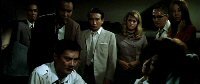
Yet despite the fairly ordinary vampire/body snatcher stuff, the film really wins on visual style, use of color, and the straight-up drama stuff between the characters. There's the whole "survivors coping with each other and the natural tensions that arise" thing going on, as well as the tensions between characters that existed before the situation got freaky. I loved the relationship between the politican and the business man. The director does a fantastic job of fitting all of his characters into the frame at the same time, giving the film a very claustrophobic feel:
(contrasted with wide, high shots later in the film of characters running along a barren and empty terrain)

The use of color is extraordinary, with reds, whites, and blues being used to great effect:


On a storytelling level I thought the characters and their relationships with each other were great: the corrupt politican, the sychophantic business man, the emotionally frayed Vietnam war widow, the know-it-all psychologist, the co-pilot whose virtue and basic humanity are the only things the viewer can be sure of in this nightmare. There was a lot of psychological and sociological stuff being addressed in the film that really had nothing to do with the science fiction/horror element and the movie could have worked even without the Goke vampire stuff (don't misunderstand me, I love sci-fi and horror, but it just so happened that in this instance I was more interested in the "normal" stuff than the weird stuff -- and just to be fair, there was one moment in the film that really did scare me and that was when the Goke possessed one of the characters and was "speaking" through that character; the Goke's voice in this scene was frightening, and the way the scene ends was chilling). The drama between the characters was often more compelling than the drama of the vampire scenes. Of course, the vampire stuff (the bloodlust and violence of the Goke) was just a metaphor for the bloodlust and violence of humanity. The film asks us to think about who the real "monsters" are, the Goke or human beings. This universal point about Original Sin, about the danger of hate, envy, greed, and pride was more interesting to me than the rather weak point about Vietnam the film tried to make.

On the level of straight-up character drama, and on visuals, I would give the film a B+/A-, but because it's a relatively predictable horror/sci-fi plot I have to give it a very solid B.

(One more note: The music in this film drove my mom nuts -- there's a very high-pitched pulsing sound that we hear throughout scenes involving the Goke's space craft that just goes on and on. My mom kept going, "What IS that?!" But I loved it! It was annoying in that kind of good way that makes you wish it would stop and yet at the same time you're mesmerized by it. Leajo, think "Show show show, show show show, show show show, the show of shows show")

Tuesday, September 05, 2006

Superman Retreads

(N.B.: This is not really a review. It's more like a few idiosyncratic observations.)

I'm not sure how it happened, but my opinion of Superman Returns (Bryan Singer, B-) has steadily decreased from B+ to B to B- as time has passed. I figure I'd better commit myself to a blog entry before things get worse and Superman gets downgraded to just plain old Average C. As it is, he's only slightly above average and that's too bad. Too bad because I'm one of the few (I think) who really likes Superman (better than Batman and Spiderman and Ghost Rider) and doesn't think he's a stodgy old boy scout. Too bad, because a director with a little les nostalgia in his eyes and a little more daring could have made a fresh, sparkling film for 2006, instead of the backward-looking homage to the 1978 film we actually got. Everything about Superman Returns feels unnecessary, in the sense that if we wanted a film like this we could have just turned to the original Richard Donner film. Why make this new one?

Imagine for a moment some possible ideas for a new Superman film, a film meant to jumpstart the franchise for the 21st century (and also note that these are just a few off-the-cuff ideas I came up with, or borrowed from other, better sources):

*It's 1942 and a (Golden Age) Superman must defend the Daily Star, Metropolis, and the Allied forces from a (magical, kryptonite-fortified) Spear of Destiny-weilding Hitler. Imagine Superman fighting scientifically enhanced Nazi supermen and throwing tanks across the fields of France (and as Clark Kent, exposing Lex Luthor as a shameless war profiteer who's getting rich selling arms to the Axis).

*Imagine Superman is dying (one of Lex Luthor's schemes and the idea Grant Morrison has come up with in his All-Star Superman comic), so what else does he do except go to his Fortress of Solitude and develop a serum that gives Lois the same powers as himself for 24 hours. Oh, and he also reveals to her his secret identity as Clark Kent.

*How about Braniac as the big bad? Or maybe a riff on the "Whatever Happened to the Man of Tomorrow?" Alan Moore story? What if Superman returned and found Lex Luthor elected president?!

Any idea that has some gumption or a spark of innovation would have been just the thing to revitalize the Superman movie franchise and make it feel necessary. Instead, Bryan Singer indulged his love for the original Christopher Reeve version and delivered a well-made (boring) semi-remake. I guess I'm just not infatuated enough with Donner's movie to get all starry-eyed with this too-long (154 min.) tribute to it. Don't get me wrong: the performances are generally good (loved Kevin Spacey), the special effects dazzling (loved the bullet glancing off Superman's eye), the story well-told (if ill-chosen). But did we really need another Lex Luthor land scheme? (Lex Luthor O'Hara: "Why Kitty Scarlett Kowalski, you mean to tell me that land doesn't mean anything to you?! Why, land's the only thing that matters, the only thing worth fighting for, worth dying for. Because it's the only thing that lasts." *unless Superman throws it into space of course*)

Was Singer's notion of a fresh idea really just to add a cute kid to the mix? Wow, I can't wait to see the sequel in which Superman agonizes over what to do about his bastard son. That sounds like a great storyline for a superhero movie!

Seriously, I sound a lot harsher about this movie than I really feel. I did like it. It's just a disappointment insofar as it's supposed to be a restart of the franchise and instead it just feels like a retread of a movie from 30 years ago. Superman returned alright. I just wish he could've flown in a different direction.

Monday, August 21, 2006

The 2006 Summer of Movies -- "What's a good movie we can go see?"

I'm often asked this question by my parents when they're thinking about going out to the movies. My parents are in their 50s, pretty conservative, and not really into action or big-budget type stuff. And they're also like many of the older set who often deplore the increased sex and violence of "today's movies" (where they were during the Godfather/Taxi Driver/Last Tango in Paris 1970s I'm not sure -- Mom: "Having babies.")

In fall, winter, or spring I usually suggest a political thriller or a (non-SNL-alum) comedy. But in the summer, when nearly every movie has either spandex or Will Farrell, it's slim pickins. This summer, when the question finally arrived, I tentatively suggested Superman Returns, hoping my dad would forget his antipathy toward superhero movies 'cause, well, it's Superman, and Superman is, like, actually pretty normal and mainstream and stuff.

Well. . . no. Superman Returns was not going to happen.

Then a brainwave! What was my favorite movie of the summer so far? CARS! Cars was funny but not stupid-funny. Cars was a good story but not a story exclusively for children. Cars was gorgeous to look at. Cars was fun. Cars was like a movie from Golden Age Hollywood, a Boys Town or You Can't Take It With You, that wasn't tailored to fit an age demographic but was just a good movie that any person could enjoy.

So I suggested Cars.

I might as well have suggested X-Men 3. Cars was off the table for my dad (my mom was more receptive, since she had seen The Incredibles and loved it). Why? I asked. No reply, but I knew the answer. Cars was a "no" because Cars was a cartoon. Silly Derelict, cartoons are for kids. He never actually admitted it, but that was the reason.

Thanks to the way many mainstream animated films are marketed (advertised on children's television, tie-in toys sold at McDonald's, characters' images on everything from sleeping bags to sneakers) many adults probably don't take them seriously as legitimate (adult) entertainment. They're movies you take your kids to, not movies you go see with your friends. To the average American adult moviegoer they're like foreign films or art house indies -- movies that don't even fall under the radar when looking through the paper on a Friday night. They've even been ghettoized by the Academy Awards with the Best Animated Feature category.

Why do I bring all this up? It's not a particularly novel insight on my part; many things have been written and said, for instance, on the differences between American and Japanese attitudes toward animation. But the notion struck me in a particular way recently because three of my favorite films this summer have been animated, and yet I find I can't really recommend them to my adult friends and relatives because, in their minds, animated movies aren't *really* movies. They're just cartoons.

Yet Over the Hedge (Tim Johnson & Karey Kirkpatrick, B+) is as zany and hilarious as any screwball comedy. Cars (John Lasseter, B+) is as fun and uplifting as any good sports movie. Monster House (Gil Kenan, B+) is as spooky and atmospheric as any good monster movie. Summer 2006 has been a great season for animated features, a fact I remind myself of whenever I hear the familiar (critics') cry of "disappointing summer for movies." Superman Returns may have fallen short at the box office; Pirates of the Caribbean may have fallen short at Rotten Tomatoes. But talented filmmakers who happen to make cartoons have made 2006 a pleasantly surprising summer.