Monday, June 25, 2007

Snick, snack, snorum!

One of the joys of watching movies as a child? Funny hair!


A pretty relaxed movie (there's not much tension, even during the inventive wizards duel), with a plot consisting mostly of charming little episodes and the bare minimum of story (Wart learns brains over brawn, pulls the sword from the stone, becomes king of England, and... FIN). But I'm still charmed by Disney's The Sword in the Stone (Wolfgang Reitherman, 1962) (with story and character design by Bill Peet), even after watching it dozens of times as a child. I think the characters are the strength of the movie, from the curmudgeonly Merlin, to the really, really curmudgeonly Archimedes, to the perfectly revolting (Why, thank you dearie!) marvelous mad Madam Mim. From the swishy-ness of Pellinore's mustache, to the walrus stomach of Sir Ector, to the cro-magnon face of Kay, to the skin and bones (literally!) of Wart -- character design, voice acting, and the script all come together to create vivid, memorable characters, so that even though the story is slight, the characters are for real. Plus: Hokety, pockety, wickety, wack! Zim zaba, rim BIM! and Prestidigitonium! are just too entirely awesome to comprehend. Also: BLOW ME TO BERMUDA! never gets old. Heh.

Friday, June 22, 2007

It's Summer, La La La!

I was outraged and excited and appalled and heartened and disappointed and confused and encouraged (oh how it will inspire the masses to watch more silent movies!) and annoyed and interested about the new AFI's 100 Best American Films for about 20 minutes, and then I suddenly got extremely tired of the whole thing. I mean, just utterly exhausted with the thought of thinking about it anymore.

It's not that I'm anti-list or anything, I usually love to pour over "best of" lists of all kinds (and I mean all kinds, even of things I have absolutely no real knowledge about, such as best architectural structures of the 20th century or something) and fume silently over all the TOTALLY WRONG CHOICES! OMG I CANT BELIEVE THEY LEFT THAT OFF THOSE BASTARDS!!1@ etc. (Do go here, though, for some intelligent and awesome commentary on the AFI list.)

But, well, it's f-ing summer and I just can't be bothered with Establishment lists and the "movie draft" that follows, where cine-types argue for who should get picked over whom (this year Raging Bull went fourth in the draft while The Graduate fell a few spots more than expected, but eccentric-blogger-guy would have taken a risk and gone with The Wind and more Sam Fuller, etc. etc.). Seriously, I thought about doing my own counter-list for about five minutes and then I realized I was just underwhelmed and bored by the mere five minute thought of it. It's summertime, la la la! and I guess I'm just feeling less inclined to think about big think-pieces or canon-making.

Basically I'm watching all these old movies from my childhood and reminiscing, rediscovering, relaxing -- the Three Rs of Summer! -- and it's much more fun to just write frivolous posts about 80s movies. That, in fact, is what I love so much about this whole movie-blogging thing. I don't have to have an official position on the AFI's 100 Greatest American Movies list!!!! Yay! I'll just watch and post about The New Adventures of Pippi Longstocking and just forget about everything else. Which is what I intend to do. La la la.

Quick Grades

Spiderman 3 (Sam Raimi, 2007, B) (I like crazy, overstuffed messes, okay?)
Knocked Up (Judd Apatow, 2007, B+)
Nights of Cabiria (Federico Fellini, 1957, A)
Ratatouille (Brad Bird, 2007, A)
Bringing Up Baby (Howard Hawks, 1938, A+) (Yes, I've seen this one before, but it's been awhile and I had forgotten how completely hilarious this movie is -- let's just say, I don't give out A+s very often.)

Tuesday, June 19, 2007

If I Were a TCM Guest Programmer...

Since I am both forgetful and lazy, I didn't enter the Turner Classic Movies Guest Programmer contest. In a way, it's for the best, since I'm kinda camera shy and would hate to be on television, even if it meant getting my movie choices shown on my favorite channel. But.... if I were going to be the TCM Guest Programmer, these are the movies I'd pick (and please note, these are not necessarily my all-time favorites -- though one is -- just four movies that I think deserve a wider audience and would make for a night of entertaining TV):


1.) The Strawberry Blonde (Raoul Walsh, 1941): This is one of the reasons I love the Golden Age of Hollywood. A movie that's simply entertaining, with Cagney, DeHavilland, Carson, and Hayworth all at the top of their game. Funny, romantic, wistful, true to the small and great ironies of life, insightful about human faults and vanities -- simply a well-made and well-told story. It's not an ambitious film like Citizen Kane or Gone with the Wind; it's not one of those accidental miracles that resulted in cultural immortality like Casablanca or The Wizard of Oz; it's not an iconic film for any of its four stars. And yet at the end of the day, I never get tired of this movie. Every time -- and I mean every time -- this movie is on television (it's not on DVD... grrrr) I sit and watch it. I think I've seen it close to seven or eight times, and I could watch it a dozen more. It's the epitome of classic studio era movie-making: Nothing spectacular or groundbreaking, simply a really, really good and entertaining movie. Utterly enjoyable.


2.) Waterloo Bridge (Mervyn LeRoy, 1940): I've never seen the pre-Code original of this one, though I've read many times that that 1931 film is superior. I can only guess it's because the earlier film doesn't refuse to mention the heroine's profession (the oldest one, in this case), and doesn't waste time on any of that dreamy 1940s romanticism. Apparently the older film is better because it's "modern," "grittier," more "sexually frank," more "open" in its subject matter and unwilling to sugarcoat the harsh realities of life. Okay, whatever. Give me lush romance, tragic heroines, candlelit dances, "Auld Lang Syne," and characters who can't bear to utter the scandalous word "prostitute," over some dreary early '30s social drama about a hooker with a heart of brass (and yes, I realize I'm being unfair to a movie I've never seen). I much prefer Vivien Leigh's tragic dancer Myra, whose heartbreak and fatalism lead her to a life of prostitution, than a pre-Code Myra who has always been a prostitute, but who falls in love with a naive boy and wants to change for his sake but knows it's too late, the set-up of so many "a prostitute makes nice" stories. Leigh's Myra is a strange bird, a young girl with no family and ambitions to dance, a beautiful girl who at the same time has a morose quality, an inkling of the possible futility of life, that gives her a deep, complex sadness. Robert Taylor, a man of action, a child of privilege who bounds through life with reckless abandon, and yet he's drawn to the sad, strangely mature, delicately beautiful girl. And of course, it's all heartbreak and ill-fate. I could write pages about this movie, and maybe someday I will. But at least I can share my love with the Chinese, who apparently love this movie, since it was one of the first American films they were able to see after the war ended. I'll just end by saying, there's a scene in this movie (at a candlelit restaurant) that is perhaps one of the most romantic ever put to screen. And yes, I'll stand by that overstatement!


3.) Libeled Lady (Jack Conway, 1936): I just really love William Powell and Myrna Loy together, and this is one of their best non-Thin Man movies. Jean Harlow gets to let fly some pretty good zingers. Spencer Tracy is playing one of my favorite 1930s movie types, the hard-boiled reporter who seems to only care about the paper and not his girl, but in the end we know he's just a big softy who's deep in love with his long-suffering lady. But it's Powell and Loy I watch for, and it's Powell and Loy I love. Their on-screen chemistry is so natural, so electric, so sexy and yet still so beguilingly normal, you feel like you're just watching two ordinary people in love, and who are so interesting you just can't take your eyes off them. This movie is more a comedy of errors than it is a true screwball comedy, but it often gets compared unfavorably to the classic screwballs of the era like My Man Godfrey or Bringing Up Baby as being a lightweight of the genre. That's too bad, because Libeled Lady has a pretty witty script, and is able to be funny without being zany (though Powell's battle with a walleye is slapstick at its best). The characters are more realistic than your average screwball denizen (though Harlow's brassy Gladys and Tracy's hard-nosed Haggerty are still somewhat ridiculous, this being, after all, a comedy). Having more down-to-earth characters means the film has some great quiet moments, especially between Loy and Powell, that are tender and touching.


4.) Gypsy (Mervyn LeRoy, 1962): I know we're supposed to complain about Rosalind Russell getting the part over Merman; I know we're supposed to think Mervyn LeRoy is an average director and the film doesn't have much visual flair, especially in comparison to the great Freed Unit MGM musicals; I know we're supposed to condemn the singing, since Roz couldn't do her own, and the dubbed voice by Lisa Kirk is only "okay" (and too deep), and Natalie Wood had a pretty enough voice but it was just too thin -- I know all this, and how Gypsy was the beginning of the end of the era of successful musicals in Hollywood. But, well, sometimes we watch a movie in our youth and it's a transcendent experience, and even if we know we should know better, we can't help loving it unreservedly, because it's a part of us, a singular artistic experience with transformative power. I was in my early teens, with a secret dream of going into show business, of "making it big," and Gypsy, an almost forbidden pleasure, watching it past midnight on a school night, spoke directly to my inner Rose. If there's one movie on this list that's a "movie that's important to me," Gypsy is it. I wish I could say my important-to-me movie was a great classic, something impressive, like The Rules of the Game, but it's not, it's a second-rate musical from a non-auteur, with a star -- Russell -- who many claim was wrong for the part. But movies that shape us, that grab hold of us and change us, are often not the movies we expect. At thirteen years old, in those dangerous hours past midnight, I had Gypsy.


So that's my night of movies in fantasy TCM-land. Anyone else willing to pick their four? Believe me, it's hard to limit yourself to just a quartet.

Monday, June 18, 2007

Quote of the Week

"I think acting should look as if we're working a little. Which is a very old-fashioned theory today. See, we mustn't have any idea that anybody knows the camera's on them at all. You see, it's just 'life.' Well, we all have life, twenty-four... twelve hours a day. Sometimes we want to forget life. I think it should be a little larger than life. A little bit theatrical."

Bette Davis

Wednesday, June 13, 2007

VERLANDER!!!


First Tigers No-hitter since 1984. 6th no-hitter in Tigers history. Pitches were faster in the 9th than in the previous 8 innings (102 MPH on the second-to-last pitch). 12 strikeouts. As they say: That's Nasty!


Monday, June 11, 2007

Film and Sports


Interleague play meets Hitchcock! Birds descended on Comerica Park yesterday and it was kinda hilarious. This is the ESPN recap of the game, and make sure to watch the video highlights to see the full effect of the birds. It's been reported that when Tiger's reliever Tim BYRDak came into the game, the gulls were somewhat pacified. At any rate, go Tigers!


Beware of birds!

Thursday, May 31, 2007

Fantasia Will Amazia!

I fell asleep during Fantasia. It was re-released in 1990 for a 50th anniversary, I was nine and the daughter of a classical music buff (my mom), and so we saw it. Most lasting memory of the film? This image:


Yes, practically the first image of the film, I know. But at nine years old Fantasia is a little tough to take in a movie theater setting: you can't stop the movie for a lunch break or to run around outside for a few hours, you just have to sit there in the darkened cavern and try not to fall asleep. That silhouetted image of Stokowski was pretty powerful though; it stayed with me and not just because it was the first scene of the movie. There's something elemental about that shot, something basic. Who is he conducting? Who is he? The silhouette, the glowing blue background, it's almost like he's a phantom, a shade, calling forth images from some netherworld. I don't think it's an accident that the film includes sequences like the Sorcerer's Apprentice, or the Rite of Spring in which the conductor seems to be bringing the very world into existence, from a blue nothingness to a world teeming with life and dinosaurs. Watching the movie today, I still get a little thrill from seeing the conductor raise his shadowed arms. This is one of the reasons I wanted to do a childhood movie series, to re-experience those thrills, to remember what it was like to watch movies as a child and to see if the movies might still work their same magic, even now, some ten or fifteen years later.

I've seen Fantasia since that day seventeen years ago. In fact, I remember getting the VHS tape out on many a lazy summer vacation day just to watch the Night On Bald Mountain sequence over and over again. And I do remember watching the Sorcerer's Apprentice section of the film in the theater, as well as the funny hippos and alligators do their Dance of the Hours ballet, and of course, A Night On Bald Mountain. I think the part that put me to sleep in the theater was the Rite of Spring section; Stravinsky's Rite of Spring is not exactly a kid-friendly piece of music (I think it's tough even for adults to get through). And I'm sure I slept straight on through the Pastoral Symphony and was only awakened by the peppiness of Ponchielli. At least, that's how I remember it. Funny, even as a kid, the most kid-friendly section -- The Sorcerer's Apprentice -- was probably my least favorite part. For some reason, it seemed so contained, so ordinary compared to the wild worlds of stuff like the nature ballet of the Nutcracker Suite or the phantasms of A Night On Bald Mountain. Mickey Mouse and inanimate objects coming to life? That seemed as ordinary to me as a Saturday morning cartoon.

Watching the movie again now, I can't say my opinion has changed about The Sorcerer's Apprentice -- still my least favorite section. Which is funny, since apparently, that section always seems to get the most praise from both critics and casual viewers alike. Though I do love this shot:

That's pretty frightening: an army of brooms, marching in lock-step, uncontrollable, single-minded in their mission of aquatic destruction. I feel like I'm watching a Leni Riefenstahl film by way of Fleischer Studios. Also somewhat scary? This guy:

According to the animators interviewed on the DVD re-release documentary, this cocked-eyebrow face was modeled after a face Walt Disney himself often made. I once dreamed of being a Disney animator, but I wouldn't have wanted to see that creepy eyebrow pop up whenever Uncle Walt was displeased with my work.

Even though the Sorcerer's Apprentice wasn't and isn't my favorite part of the movie, I did spend a lot of time copying Mickey's image from it. Like I said, I wanted to be to be a Disney animator when I was between the ages of seven and eleven. I spent hours copying this image:

I think I remember it so clearly because it was one of the first things I drew free-hand that people thought I had traced. Nope! All done free-hand, no tracing for me! At nine years old, I was so proud.

Watching the film again a few weeks ago, I was, frankly, kinda blown away by it. As a child, certain sections were powerful and made an indelible mark (see: Night On Bald Mountain), but the film as a whole wasn't something I remember wanting to watch, the way one would want to pop in Lady and the Tramp or Back to the Future or Goonies. Watching the film now, I'm struck by, yes, certain sections (see: Night On Bald Mountain), but also by the film as a complete film. Each section could be watched individually, each separate short film existing independently of the others. But I think the sum of the film is actually greater than the parts. Or, to put it another way, I think each individual part comments on and enhances the enjoyment and understanding of all the other parts. The film starts out with Bach's Toccata and Fugue in D Minor, the "abstract" piece of music ("music for its own sake" as the film describes it) that is accompanied by meshes of color and squiggly lines and generally abstract animation, but notice this image towards the end of the piece:


In this piece, "pure" music with no story or dominant idea contained within the music itself, and the Disney animators happen to stick a sunrise/sunset into the thing. Later on the sun will show up as a destroyer of the dinosaurs in the Rite of Spring section:


After Zeus's thunderstorm in the Pastoral Symphony:


And then finally, the last shot of the film, after the nightmares and spectres of Bald Mountain have gone back to their shadows, the pilgrims make their journey through the forest with lighted lamps (metaphors for the sun?) as Schubert's Ave Maria weaves its way into the soundtrack, and they walk into a cathedral made of trees, which open up to reveal the rising sun in all its glory. The music builds, the light grows stronger, and at last, a sunrise, an eternal symbol of hope and the film ends:


And gosh, don't those hills look a little bit like those weird rolling hills from the first section, the Bach Toccata and Fugue?:


The sun imagery is just one repeating theme throughout the film, and I think nature imagery as a whole is the dominant visual theme of the movie. Nature as living thing, maybe even magical (Nutcracker Suite); nature as volatile force, creator and destroyer (Rite of Spring); nature as divine (Pastoral Symphony); nature as healer, giver of hope (Ave Maria). There is also the theme of creative forces, which I mentioned earlier, of creating new life, as represented in the Rite of Spring section and the Sorcerer's Apprentice section. Even in the Toccata and Fugue abstract section, there's a sense that the music itself is somehow willing these images into existence. And the section least thematically tied to the others -- the Dance of the Hours comedy -- still has in the background the changing times of the day: the brightness of midday, the pallor of dusk, the haunted dark of night (which, of course, happens right before the Night On Bald Mountain sequence -- again, each section builds on and comments on the others).

I watched the movie twice in two days when I rented it recently -- a response I was not expecting, frankly. And then I watched it in pieces again for a third time, and each time I watched it I noticed something new, or I caught a new connection, or a new theme. I even noticed things that I've seen echoed elsewhere in other films. This image, for instance:


looks almost identical to the last image of Peter Jackson's The Two Towers (minus the nazgul and fell beasts, of course), where the camera pans up and reveals a hellish shot of Mordor, looking like something out of Dante's Inferno (or now, as I see, out of Disney's Fantasia).

I mentioned the word "elemental" earlier, in reference to the silhouetted conductor's image, and I think that word sums up the experience pretty well. It's animation and cinema on that pure level, on the level of just moving images, as if one is seeing color and line and form all explode for the first time. The emotions and themes of the piece are basic as well:

Fear:


Life:


Death:


Beauty:


Joy:


Evil:


I have to say, I was exhilarated after watching the film recently. I know Pauline Kael called it kitsch, but, if it is, it's the most dazzling, ambitious, and thrilling kitsch I've seen in a long time. There's a sense, after watching it, that one's just witnessed the birth of some new kind of life.

Monday, May 28, 2007

Whenever I Go Blog Rolling, I Always (BLANK) Victor Morton

Victor over at Rightwing Film Geek returns to blogging with a nice tribute to Charles Nelson Reilly and the awesomeness of Match Game:

Wikipedia claims that MATCH GAME "pushed the boundaries of 1970s television standards." That may be the case, but it misses the point that the boundaries remained and were, in fact, key to what made their bickering so funny and so enduring. Charles and Brett and Richard and Gene were brilliant comedians because they knew how to deliver a dirty joke in a clean way, in the classic double entendre, which has become a lost art as content standards have waned. But this pre-pubescent MATCH GAME fan remembers all the innuendo (which the adult fan well catches) going over his head. In fact, what is very much part of the fun (watching it now at 40) is appreciating the tension in how the MATCH GAME team were so deft as to get away with so much while keeping the surface G-rated. Sex and sexuality are legitimate subjects for humor, and I have no per se moral problem with locker-room jokes. But the double entendre is not only funny, but respects the innocence of some in the audience through its "double meaning" (in a slightly different context, Ernst Lubitsch noted that if you tell the audience "2 and 2," they don't need to be told "4"). But when comedians can say whatever they want, you don't need a Bocaccio to write in "The Decameron" of a randy groundskeeper at a convent that "he tended all their gardens."

I was a teenager when I experienced the genius of Match Game, watching reruns on the Game Show Network with my mom. At first I thought it was hilariously tacky in the way so much of mainstream 70s culture seems to those of us who had our childhoods in the now ironically hip 80s. But the more I've watched it, and the older I've gotten, the more I'm convinced that my grandparents' generation was a lot cooler, a lot funnier, and a lot smarter and more sophisticated than anything my generation could hope to achieve.

Michael Gerardi also gets back in the game with a review of The Freshman and reminds me I should go watch the DVD of that movie I recorded a few weeks ago.

I'm sure everyone's already seen this, but it's new to me: Classic movies and others get the Grindhouse treatment! Example:


That Little Round-Headed Boy discovers Howard Hawks's Scarface, David Bordwell and Co. discuss movie sequels and RightWingTrash celebrates the Addams Family's contribution toward winning the Cold War:

Of course, Lurch turns out to be the opposite of what Haan imagines as a “poor weak victim of exploitation.” The butler carries around a cigar-store Indian to see who cares for a smoke. This is the same Indian that Klarpe was examining closely before with much distaste. The Addams family would get a similar reaction if Sheryl Crow came by for a visit.

The Russians decide that Lurch is a robot. Harris tries to explain the truth, but can’t convince them. At least Haan and Klarpe can calm down enough to enjoy a nice lunch. They’re impressed to get caviar, but Morticia explains that they’re eating eye of tadpole. (Blue-eyed tadpole is better, Gomez adds, but it’s out of season.) Klarpe adds that American beef is fine, but not as good as in his country. Wrong again, since he’s dining on alligator.

Terry Teachout's Entries from an unkept diary:

Though the metaphor embodied in its nickname is long dead, everyone in the world understands that a "movie" consists of "moving pictures," and it is in the nature of a picture--a photograph--that we take for granted its unfaked reality. A century ago, our great-grandparents were scared out of their wits when one of the villains in The Great Train Robbery pointed his gun at the audience and fired it. Nowadays we're more sophisticated than that, but most of us still cling to the belief that a film is in some attenuated but still meaningful sense a record of something that actually happened, if only on a soundstage.

Will our children feel this way about film? I doubt it.

And Jon Hastings at The Forager Blog has started his movie club.


Saturday, May 26, 2007

I Wake Up Screaming!

A 1941 movie with murder, obsession, ambiguous characters with hidden motives, Elisha Cook Jr., a flashback narrative structure, and shots like these:


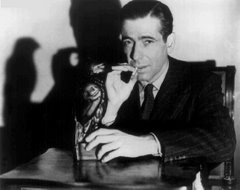
And it was made at practically the same time as The Maltese Falcon. Was this Betty Grable/Victor Mature vehicle from Fox more "noir" than the so-called "First Film Noir"??? Well, the happy love story stuck in the middle of the all the creepy dark stuff seems to say "no" (and who knew that "Somewhere Over the Rainbow" could get more play in this movie than in Wizard of Oz!). But wait for the end (sorry, no spoilers here) and tell me that doesn't seem as twisted as anything from the traditional Noir catalogue. Also, stylistically, it looks way more Noir than Falcon.

Thursday, May 24, 2007

Fantasia Image of the Day

LAME

I have a couple of questions for you LOST: Why did Charlie lock the door and basically commit suicide? Couldn't he have gotten out of the room before the bomb went off? There seemed like a lot of time between the moment Patch Guy showed up with the grenade and the time it took Charlie to lock the door, look meaningfully at Desmond, and wait an eternity for the bomb to go off. Couldn't Charlie have just gotten out of the room and let the grenade go off without locking the door? It would've taken twelve years for that cavernous hatch to fill up with water and by that time Charlie and Des could've been half-way to the island. Charlie's death, meant to be so meaningful and self-sacrificing (which it was, only needlessly so), ended up making no sense. Charlie just basically committed suicide for no reason, and it could have been remedied so easily if the writers had just decided to have the door lock behind Charlie so that he couldn't escape. Instead, they went for the extra-special-self-sacrificing version, even though Charlie's sacrifice was already heroic without this added-on really, really "heroic" (lame) stuff. It just makes Charlie look like an idiot (also, when did Charlie convert to Eastern Orthodoxy? Nice backwards sign of the cross, Chuck).

It's funny because I've always liked the Charlie character but I was actually hoping they would kill him because it would be heroic and give the character a real, meaningful death. I was actually looking forward to Charlie's death scene, one because it would be a nice way for the character to go out, and two because I like Dom Monaghan and I want him to move on from this train wreck show. Oh well (which is so often my reaction to a missed opportunity by LOST).

The problem with this scene, and with so many other moments on the show, is that the characters don't act like real people. A real person, when faced with the cryptic bullshit of the Others, would get angry, demand answers, maybe even get a little violent (which Jack finally did, thank God). Usually, the Losties just shrug their shoulders and drop it, which is just not a normal reaction. Charlie has the opportunity to save everybody and still live, and instead he basically kills himself. For what? Because Desmond said he had to die? The implication was always that Charlie had to die to save the Losties because there was no other way. But in the finale, it turns out there was another way. Several, in fact.

I'll probably still watch next season, though. I'm weak. But good for Dom that he can move on to other things. He deserves better than playing sixth banana on a sloppily written TV show.

Wednesday, May 23, 2007

Sometimes Cinematic Perfection is Boring: Pinocchio vs. Dumbo

Pinocchio: I remember nearly everything about the film -- as I was rewatching it for the first time in probably thirteen years, as each scene began, as each song started up, as each character arrived, it all came rushing back to me in an instant, and I remembered everything completely. It was like thirteen years had never happened, that's how clearly I remembered the film as I rewatched it. I'm convinced now that I must have watched Pinocchio A LOT as a child (though I don't remember watching it that much...) because the experience was so familiar. If nothing else, Pinocchio as a whole made a much stronger impression on me as a kid than Dumbo did. And yet, watching it now as an adult, I have to say, it's lost some of its impact. The Pleasure Island sequence in particular, a sequence that scared the pants off me as a child, doesn't seem to pack the same punch. I can certainly understand, watching the film as an adult, why and what it was about that sequence that so disturbed me as a child (I hated when people transformed into things), but now I find it doesn't even really give me a slight chill, not even in remembrance of past frights:


Dumbo, on the other hand, a film I remember finding immensely sad, almost unbearably sad, but not really remembering too much else about, is, upon rewatching, a kind of delightful discovery. I know Pinocchio was painstakingly crafted and Dumbo a slapdash product; I know Pinocchio has better songs, better animation, and a better narrative; I know Dumbo plays too easily and too readily on our heartstrings, while Pinocchio has sentimentality without being cloying. But, gosh darn it, I like Dumbo better. And this isn't a "when I was a child" reaction. I'm not sure which film I liked better as a child; in fact, I think I disliked both in a way, Pinocchio for being too scary, and Dumbo for being too sad (and also a little scary -- hello clowns and pink elephants -- for some reason, this image in particular used to scare me; I'm sure this is what prompted Dumbo's mind to invent the pink elephants):


But today, Pinocchio, though I still like it very much, comes off as a little too didactic and overly cute, while Dumbo seems almost experimental, like Merrie Melodies meets Expressionism meets Charlie Chaplin meets LSD. There's a part where Timothy the mouse tells Dumbo that there are plenty of famous guys with big ears, and he doesn't mention who, but it's obvious we're meant to think of Mickey. This kind of self-referential humor is something I'd expect more from a Warner Bros. cartoon than a Disney feature film. Coming after Snow White and Pinocchio, two features that practically define the detailed, pretty, and naturalistic style of Disney animation, Dumbo really feels like the animators were trying any new thing they could think of. Take a look at this shot:

Is this Disney or an impressionist?

And before that we got an anthropomorphic, cartoony train:


And the use of silhouette for shots of human characters, especially the clowns, somehow made them scarier and more menacing, at least when I was seven. It was also a nice device for separating the human world and the animal world, turning the human world into a strange, unwelcome, mysterious place, and giving the viewer a real sense of the animal point of view:


It's like the animators just stuck in a bunch of crazy art things that they wanted to experiment with. Nothing shows this clearer than the Pink Elephants sequence, which comes out of nowhere, means nothing to the overall story, and yet is totally unforgettable, and for some inexplicable reason, just totally right for this movie. This is some freaky stuff, yet perfectly suitable to a story about the circus, a relatively freaky place, especially for kids:

Fantasy turns back into reality but the line between them is blurred.

Dumbo
as a story, as a narrative film certainly doesn't stand up to Pinocchio, which has stronger themes and tells a more interesting story, but Dumbo is so freewheeling, and yet so basic and simple, that it has a freshness that Pinocchio, for all its true strengths as a film, can't seem to match. Pinocchio feels older, much older in fact, than Dumbo [though Dumbo is unfortunately very dated in its racist depiction of the minstrel show crows who help Dumbo learn to fly]. In that sense I'm drawn to Pinocchio because it's nostalgia in two respects: nostalgia for my own childhood, and nostalgia for a bygone era -- Pinocchio feels older than its 1940 date; it feels like something from the turn of the century was finally discovered in 1940:

And Pinocchio does have better songs.

Also, there's some scariness:


But Dumbo, for all its flaws is simply more interesting. I think my reaction to it has a lot to do with my affection for noble failures; I seem to fall in love with movies that have obvious flaws but also flashes of real brilliance. The whole is not as great as some of its parts, and yet those parts are so interesting, engaging, intriguing, whateveradjective, that I can't help but love the movie. Sometimes cinematic perfection is boring; sometimes a movie is so good that there's nothing to think about or muse over afterward. Dumbo is not like that; Dumbo is the kind of film that worms through my brain and I can't get it out. It's not so much the story or the songs but the images and essential emotions like fear, shame, sadness, and joy. Plus, who can resist this level of cuteness?


Who doesn't cry when they see this?


And who doesn't freak out over elephants in mind-bending Technicolor?


My reactions to these scenes are too strong to dismiss simply because the film is weak narratively. Pinnochio is Disney perfection, but Dumbo is Disney intoxication.